Thursday, May 13, 2010

another fact of slathul fthih

Important of Salat al-Fatih by Sheikh Abul Abbas Hammad Tijani (RTA)


The journey of Salat-al Fatih started from Sheikh Naksabandi (RTA) ( AL Torikat Naqshbandiyah ) who is a great saint, that pray to Almighty Allah to inspired him with a different formula of prayer for the holy Prophet and the kind of prayer that is greater than any other prayer (ASSALATU). And he was inspired with Salat-al fatih but has to wait for Abul Abbas Hammad Tijani (RTA) for the key.
Out of all the authentic formulas to shower prayers upon the Holy Prophet (peace and blessing be upon him), Sidna Sheikh, the Seal of Saints, the Known Mohammadian Seal, the Concealed Pole, Moulana Abul Abbas Ahmed ibn Mohammad Tijani (may Allah be satisfied with him), prompted his companions and beloved to apply the peerless and stunning Prayer of Salat al-Fatih because of the great benefits that are in it. Sidna Sheikh Tijani (may Allah be pleased with him) has received in broad daylight many prayers from the Holy Prophet (peace and blessing be upon him) such as Jawharat al-Kamal (The Complete Jewel) and Yaqutat al-Haqaiq (The Jewel of Realities). However, Sidna Sheikh stressed the application of Salat al-Fatih like no other. When some of his companions were seeking another prayer, Sidna Sheikh used to say: “Set many prayers upon the Prophet (peace and blessing be upon him) with Salat al-Fatih because in it is the good of this world and the Hereafter, and by Salat al-Fatih one obtains all his desires and reaches all his wishes. On the reward of Salat al-Fatih, al-Khalifa Sidi Ali Harazem reports in Kitab Jawahir al-Ma'ani,
Sidna Sheikh said: I have asked the Prophet (peace and blessing be upon him) on the reward of Salat al-Fatih to which he (peace and blessing be upon him) responded, "it is worth six thousand (6000) recitation of the Holy Quran'". Verily, Salat al-Fatih is a divine matter which has no room for the mind intellect. If we were to estimate there are 100,000 nations each nation is made of 100,000 tribes each tribe is made of 100,000 men each one of those men lived for 100,000 years and recited 1,000 prayer upon the Prophet (other than Salat al-Fatih) every day of their lives then the reward (thawab) for all of these nations along all these years would not catch up with the reward of one times of reciting Salat al-Fatih!
The venerated Tijanite Sheikh, Sidi Abul Fadl al-Haj Omar ibn Said al-Futi Tall (d. 1279/1864) informs in the book entitled the "Rimah al Hizb al Raheem ala Nuhur al Hizb al Rajeem" (The spears of the league of the Merciful thrown at the necks of the league of the accursed),
As for the invocation of Salat al-Fatih it has three degrees: an external degree, an internal degree and the degree of the inmost (batin al-batin). I had intended to provide a complete explanation of it at this point, and to describe its marvels and its wonders. I was prevented from that, however by the fact that most people lack the maturity required for the acquisition of that kind of knowledge. I shall therefore content myself with mentioning some of what is available in Kitab Jawahir al Ma’ani concerning the external degree;
Sidna Sheikh has said: "As for Salat al-Fatih when I asked the Prophet about it, he informed me first of all, that it is worth six hundred thousand invocation of blessing (600,000). I also asked him, ‘For each invocation of blessing does one bird fly up toward heaven-that being the bird which has seventy thousand wings, as described in the Hadith, or do six hundred thousand (600,000) birds of that kind fly up each time, and is the reward of their glorification assigned to the invoker of blessing upon the Prophet?’ The Prophet replied: "Six hundred thousand birds of that kind fly up each time."
As for the number of each bird’s tongues, the Sheikh said, "The total number of its tongues is 1,680,000,700,000,000,000,000.000. Each tongue glorifies Allah in seventy thousand languages in a split second, and all of is reward is assigned each time to the invoker of blessing upon the Prophet. This applies to every prayer on the Prophet than Salat al-Fatih. As for the latter, it gives rise, each time, to six hundred thousand (600,000) birds of the kind described, as previously mentioned." Sidna Sheikh then went on to say, "When I asked the Prophet about the authenticity of the Hadith, 'The invocation of showering a prayer upon him (salat 'ala Sidna Mohammad) one time, is worth the reward of four hundred (400) military campaigns (ghazwa) and every campaign is worth four hundred (400) pilgrimages ('hajja).' The Prophet replied: "It is indeed authentic".
I then asked the Prophet about the number of these campaigns: ‘Are four hundred (400) campaigns equivalent to a single offering of Salat al-Fatih, or are four hundred (400) campaigns equivalent to each of the six hundred thousand (600,000) invocations of blessing?’ The Prophet answered: Salat al-Fatih is worth six hundred thousand (600,000) invocations of showering a prayer upon him one, and each of the six hundred thousand (600,000) invocations of blessing is worth four hundred campaigns’!
Then he went on to say: If someone invokes it (Salat al-Fatih); one time, he will receive the reward he would receive if he offered every invocation of salat upon the Prophet ever offered in the universe, by all the jinn, human beings and angels, six hundred thousand times (600,000), from the beginning of time until the moment when he utters its invocation. In other words, it is as if he has offered six hundred thousand times (600,000) all the invocations ever invoked by all the invokers of salat, angels, jinn and human beings, every one of those invocations being worth a spouse among the houries (al-'hur al-'in), and ten good deeds ('hasanat), and the erasure of ten bad deeds (sayyiat), and promotion by ten degrees (darajat). Allah and his angels will also bless him ten times for every invocation of blessing. Sidna Sheikh then said: Once you have contemplated this with your heart, you will know that no act of worship is equal to a single offering of the salat upon the Prophet, so how about someone who offers it many times?" What gracious favor he enjoys in the presence of Allah, and this is received each time

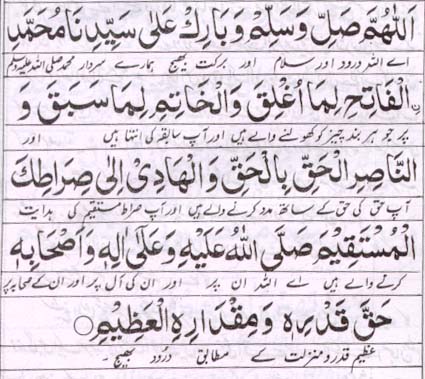
Salawat Al-Fatih (durood Fatih)

Salat Al-Fatih is held in particular esteem with the Tijaniyya Order. In English, it goes like this:-

O God bless our Master Muhammad (pbuh) who opened what had been closed, and who is the Seal of what had gone before, he who makes the Truth Victorious by the Truth, the guide to thy straight path, and bless his household as is the due of his immense position and grandeur.

the above transliteration is :-

Allahumma salli ' wa sallim was baarik ala Sayyidina Muhammadil

nil-fatihi lima Ughliqa wal khatimi lima sabaqa wan-naa-siril-haqqi

bil-haqqi wal-hadi ila Sirati-kal-mustaqima sal-lal-lahu 'alayhi

wa 'ala alihi wa-ashaabihi haqqa qadrihi wa-miq-da rihil-'azim.

From a Tijaniyya Order member

The history of Salatul al-Fatih is this. A man named Sayyidi Bekri went into khalwa for 40 years, asking Allah to give him the best Salatul-ala Nabiyya. It was written on the wall in light and he was told not to give it to others until the owner of it appeared.

Another version but no arabic

Allahumma Salli'Ala Sayyidina Muhammadil Fatihi Lima Ughliqa wal Khatimi Lima Sabaqa Nasril Haqqi Bil Haqqi Wal Hadi Ila Siratikal Mustaqim wa 'Ala Alihi Haqqa Qadrihi wa Miqdarihil Azim.

From another Tijaniyya Order member

The reason why it is the best Salat Ala Nabi, Because all other Salat ala Nabi end with Wa Sallim, or Tasliman. Salim means Peace. Mankind is the only thing that needs peace. Allah and his angels don't need peace. Salatul Fatih ends with Azeem in the dua. But after finishing the prayer ends with Al Hamdu Lillahi Rabbi Aalimeen. Another reason it is the best and has all those blessings as you described is because it praises The Prophet before the creation of Time and it praises him After creation. The opener and the seal. It is also said to be equivelant to reading the Quran 6 thousand times. Why? How? Shaykh Ibrahim Niasse said any Salawat Ala Nabiy especially Salawatul Fatih is the Quran of Quran. Salawatul Fatih is different from other because it is the Prayer of Allah and His Angels.

Another main reason why Salatul Ala Nabi is so Powerful and great is because Only Allah can send prayers on the Prophet(PBUH). When you say Allahuma Sali You have nothing to do with the prayer anymore it is just Allah and the Prophet(PBUH). The Tariqa Tijaniyya is based on Salawatul Fatih it is the main difference between the tijaniyya and other turuq. For this approval has come from the Prophet to Shaykh Ahmad Tijani in broad daylight.

From the Tijaniyya - abun-Nasr; an excert from:- And Muhammad Is His Messenger : The Veneration of the Prophet in Islamic Piety by Annemarie Schimmel, ISBN: 0807841285

The Salat (Durood) is considered to have merits of eight categories…. He who reads it once is guaranteed the bless of the two abodes; also reciting it once atones for all sins and is equivalent to six thousand (6000) times all prayers of glorification to God, all Dhikr and Dua'a, long and short which have occurred in the Universe. He who recites it ten (10) times acquires recompense greater than that due to a Wali (saint) who lived ten Thousand years, but did not say it. Saying it once is equivalent to the prayers of all angels, human beings, and Jinn from the beginning of their creation to the time when it was uttered, and saying is a second time is like [i.e. equivalent to the recompense of the first] plus the recompense of the first a and the second, and so on.

A book of Salawat durood Shareef

It is because of this Durood that he was awarded the title Siddiq which means truthful.

Hadhrat Abul-Muqaraab says that a man's total sins will be washed away if he recites Durood Faith 40 times.

Hadhrat Shaykh Muhammad Bakari says that recitatin of Durood Faith once a day relieves the recitor from the fire of hell.

Hadhrat Syed Ahmed Hillam says the Durood Fatih was favourite routine of Hadhrat Shaykh Abul-Qadir Gilani.

The great Saints say that Durood Fatih is actual and real light.

Hadhrat shaykh Yusuf Bin Ismail says that this Durood shareef is the Greatest mystry of Allah ta'ala. It brings 100% success and happiness to the reciter

In fact this Durood brings prosperity and luck and solves all the naughty problems by the grace of Allah ta' ala.

When a man recites this Durood shareef angels of Allah ta'ala surround him, mercy covers him and peace starts descending on him.

Compiled by Muhammad Sajad Ali

Tuesday, April 13, 2010

http://www.dar-sirr.com/

Sayyida Fatima Zahra: Mistress of Womankind

"O family of the House, Allah only wishes to distance fault from you and cleanse you." (Quran 33:33) “Yes, I swear it by the Moon, and by the night when it retires, and by the dawn when it rises, this Sign is one of the greater Signs, one of those which warn human beings” (Quran 74:32-36). Abdullah bin Abbas and others reports that when the following verse of the Holy Quran was revealed: "Say: I do not ask of you any reward for it but love for my near relatives; and whoever earns good, We give him more of good therein." (Quran 42:23) a group of companions asked "O Messenger of Allah, who are those of your relatives whose love has been made obligatory on us by Allah?" The Prophet replied, "They are Ali, Fatima, Hassan, and Husayn." Some hadith contain the words "and their sons," meaning Hassan and Husayn. The Prophet (peace and blessing be upon him) said to Sayyida Fatima: "O Fatima, I give you the good tidings that Allah made you superior to all the women of the world, and made you the purest of all the women of Islam" (Bukhari and Ahmad); "You are (Fatima) the mistress of the women of all the worlds!" (Shifa); “Fatima is a part of me, and whoever angers her, angers me.” (Bukhari & Muslim) "'I am leaving you with something. Take hold of it and you will not go astray: the Book of Allah, my family and the people of my House. Take care to follow my instruction regarding them.'" (Shifa) Referring to his two grandsons, Al-Hassan and Al-Hussayn, the Prophet (peace and blessing be upon him) said, "Whosoever loves these two, their father and their mother will be with me on the Day of Resurrection." (Shifa)

Shaykh Ahmad Tijani and the founding of the Tariqa Tijaniyya

[Excerpts from Zachary Wright, On the Path of the Prophet: Shaykh Ahmad Tijani and the Tariqa Muhammadiyya (Atlanta, 2005), p. 24-77. Posted with permission of publisher.]

The tomb of Shaykh Ahmad al-tijaniSidi Abu Abbas Ahmad al-Tijani was born in the Southwest Algerian oasis town of Ain Madi on the twelfth of Safar in the year 1150 (1737 C.E.). He was a descendent of the Prophet Muhammad through Fatima Zahra’s first son Hasan and later through Mawlay Idris, the celebrated founder of Morocco. His father was Sidi Muhammad b. al-Mukhtar b. Ahmad b. Muhammad b. Salam, a prominent scholar whose family hailed from the Moroccan Abda tribe and whose grandfather had immigrated to Ain Madi fleeing a Portuguese invasion less than a century before Shaykh Tijani’s birth. This same ancestor was perhaps one of the more renowned of the Tijani line prior to Shaykh Ahmad Tijani, and it is reported that he used to engage so much in spiritual retreat (khalwa) that he would have to walk to the five prayers in the mosque with his face covered, otherwise onlookers would fall so heedlessly in love with him that they would thereafter never be able to separate from him. Shaykh Tijani’s mother, Aisha, was the daughter of Muhammad b. Sanusi (no known relation to Muhammad al-Sanusi, the founder of the Sanusiyya), and was noted for her piety and generosity.

The young Shaykh Tijani continued in the scholarly tradition of his family and city, memorizing the Qur’an by the age seven before turning to the study of jurisprudence (fiqh and usul al-fiqh), Prophetic traditions (Hadith), explanation of the Qur’an (tafsir), Qur’anic recitation (tajwid), grammar (nahw) and literature (adab), among other branches of the traditional Islamic sciences. According to the Jawahir, the Shaykh mastered all of these fields at a very young age, in part due to the force of his resolve but also because of the quality of his teachers. Among his first instructors were masters of their fields, such as Sidi Mabruk Ibn Ba’afiyya Midawi al-Tijani (not mentioned in the Jawahir as being a relation to Ahmad Tijani), with whom he studied the Mukhtasar of Sidi Khalil, the Risala and the Muqaddama of Ibn Rushd (Averoes) and the Kitab al-‘Ibada of al-Akhdari.

Shaykh Tijani’s prodigious capacity for learning at such an early age is explained in the Jawahir by the Shaykh’s own statemet: “When I begin something, I never turn from it.” In another passage describing his love for the people of religion, the Jawahir describes him as a youth of powerful intelligence, such that nothing escaped his realization. Thus it was that even after he had mastered the sciences available in Ain Madi and had become by the age of twenty, according to the Jawahir, a great scholar, jurist and man of letters such that people were coming to partake of the knowledge of this newest Mufti (a scholar licensed to issue legal decisions), his thirst for more knowledge pushed him to leave the city of his birth in 1171/1758.

The obvious destination for any seeker of Islamic knowledge in the Maghrebi context was Fes, the long-established political, intellectual, cultural and religious capital of the area. According to the Jawahir, the young Shaykh Tijani spent his time in Fes studying Hadith and generally seeking out the people of piety and religion. Among his teachers in Fes were many famous for their knowledge and saintliness. Their names are provided here to demonstrate Shaykh Ahmad Tijani’s contact with some of the more significant luminaries of eighteenth-century Moroccan Sufism. Al-Tayyib b. Muhammad al-Sharif of Wazan (d. 1180/1767), who was head of the Wazzaniyya Sufi order at the time and the student of the famous Shaykh Tuhami descending from the Jazuli shaykh Ahmad al-Sarsari, gave Tijani permission to give spiritual instruction, only to have the young scholar refuse so that he might work harder on himself before becoming a spiritual guide. Sidi Abdullah b. ‘Arabi al-Mada’u (d. 1188) was likewise impressed with his student, telling him that God was guiding him by the hand, and before Tijani left him, the old scholar washed his student with his own hands. Another scholar to predict to Tijani an exalted spiritual attainment was Sidi Ahmad al-Tawash (d. 1204). From Sidi Ahmad al-Yemeni, Shaykh Tijani took the Qadariyya Sufi order, and from Abu Abdullah Sidi Muhammad al-Tizani he took the Nasiriyya order. He also took the order of Abu Abbas Ahmad al-Habib al-Sijilmasy (d. 1165), who came to him in a dream, put his mouth on his, and taught him a secret name. Although Tijani did receive spiritual permission (idhn) in these orders, his association with them should not be considered the essential element in his spiritual development. But the imprint of his early affiliation with these orders was not completely lost with the later development of the Tijaniyya, and their emphasis on an elite “orthodox” Sufism, firmly rooted within the bounds of the Qur’an and Sunna, was an essential component of Shaykh Tijani’s new order, as will be seen later in chapter three.

Even from the time of Shaykh Tijani’s first visit to Fes, the young scholar’s ascendent motivation seemed to be the attainment of a spiritual opening (fath). So when another of his teachers, Sidi Muhammad al-Wanjili (d. 1185), a man known for his saintliness, predicted for him a maqam (spiritual station) of Qutbaniyya (Polehood) similar to that of Abu Hasan al-Shadhili, but that his fath would come in the desert, Tijani hastened his departure from Fes. The Jawahir reports that he spent some time in the desert Zawiya of the famous Qutb Sidi Abd al-Qadir b. Muhammad al-Abyad (known as Sidi al-Shaykh) before returning to Ain Madi, only to leave his home soon again to return to al-Abyad before moving on to Tlemcen. His activities during this time consisted of teaching Qur’anic exegesis (tafsir) and Hadith in whatever town he happened to be staying while continuing an apparently rigorous practice of asceticism, including frequent fasting and superogatory worship. During his stay in Tlemcen, he received through Divine inspiration greater assurance of his coming grand illumination.

It was from southwest Algeria, then, that Shaykh Ahmad Tijani set out in 1186/1773 to accomplish the requisite Islamic pilgrimage (Hajj). Shaykh Tijani’s first stop of note en-route to Mecca was at Algiers, where he met Sidi Muhammad b. Abd al-Rahman al-Azhary (d. 1793), a prominent muqaddam (spiritual guide) of the Khalwatiyya Sufi order who had received initiation at the hands of Shaykh al-Azhar Muhammad al-Hifni. The Khalwatiyya, originating in fourteenth century Anatolia, had become by the eighteenth century, under the tutelage of Mustafa al-Bakri, one of the most prominent orders in Egypt and a locus for Islamic and Sufi renewal.

Shaykh Tijani’s affiliation with this order was perhaps the most significant influence upon his thought prior to his waking meetings with the Prophet, and he did not leave Algiers before receiving initiation at the hands of al-Azhary. No doubt such an encounter would have provided additional impetus to meet, as he later would, some of the day’s most renowned Khalwati scholars, such as Mahmud al-Kurdi and Muhammad al-Samman, while passing through Egypt and the Hijaz.

Shaykh Ahmad Tijani’s journey East brought him also to Tunis, home of the famous Zaytuna mosque and university, which predates both the Azhar in Cairo and the Qarawin in Fes. Indicative of the ease with which foreign scholars could integrate into diverse Islamic communities, upon his entry into Tunis, Shaykh Tijani immediately met with the people of saintly renown, such as Sidi Abd al-Samad al-Ruhwij, and took up teaching at Zaytuna, this time his syllabus including Ibn ‘Atta Allah’s Kitab al-hikam. It seems he made enough of an impression on the scholars there for the Emir, Bey Ali (r. 1757-1782), to offer him a lucrative permanent teaching position at Zaytuna. But the Emir’s request had the opposite effect on Shaykh Tijani to that which was hoped for and, reportedly not wanting to accept dependence on state authority, he continued his journey East.

Arriving in Mecca just after Ramadan in the year 1187/1774, Shaykh Ahmad Tijani stayed long enough to accomplish the rites of the Hajj. During his stay there he also, as was his custom, sought out the people of “goodness, piety, righteousness and happiness.” His search led him to a mysterious saint from India, Ahmad b. Abdullah al-Hindi, who had made a vow to speak to no one except his servant. On knowledge of Tijani’s presence at his house, al-Hindi sent him the message, “You are the inheritor of my knowledge, secrets, gifts and lights,” and informed the pilgrim that he himself was to die in a matter of days (it came to pass on the exact day al-Hindi had predicted for himself), but that he should go visit the Qutb (Pole) Muhammad al-Samman when in Medina.

After accomplishing the ziyara (visitation) to the Prophet’s tomb, where “God completed his aspiration and longing” to greet the Prophet, Shaykh Tijani went to visit the renowned Shaykh Muhammad Abd al-Karim al-Samman (d. 1189/1775). Like al-Kurdi, al-Samman was a member of the Khalwatiyya order, being one of two students given full ijaza (permission) by Mustafa al-Bakri; the other was al-Kurdi’s shaykh, Muhammad al-Hifni. Aside for his own intellectual and spiritual prowess, al-Samman has become famous on account of another disciple, Ahmad al-Tayyib (d. 1824), who spread his ideas in the Sudan as the Sammaniyya order. Before Shaykh Tijani’s departure, al-Samman informed him of certain secret “names” and told him that he was to be the al-qutb al-jami’ (the comprehensive Pole).

On his return from the Hijaz, Shaykh Tijani stopped in Cairo and visited Mahmud al-Kurdi, the Khalwati representative in Egypt whom he had first visited on his way to the Hijaz. The Jawahir reports that many of the ‘ulama of the city came to visit the travelling scholar during this second visit. Demonstrating his profound respect for his teachers of the Khalwati tradition, Tijani accepted from al-Kurdi to be a muqaddam (propagator) of the Khalwati order in North Africa. Although Tijani’s later initiation at the hands of the Prophet would obviate its need, the Jawahir reproduces the chain of transmission (silsilah) of the Khalwatiyya, stretching from the Prophet through Ali ibn Abi Talib, Hasan al-Basri, Junayd, Umar al-Khalwati (from whom the order derives its name), Bakri, and Kurdi (not to mention all the names) to Shaykh Tijani.

The beginning of a distinctive “Tijani” order can be located with the appearance of the Prophet Muhammad to Shaykh Ahmad Tijani in a waking vision. This occurred in 1784, in the desert oasis of Abi Samghun. The Prophet informed him that he himself was his initiator on the Path and told him to leave the shaykhs he had previously followed. The Shaykh then received the basis of a new wird and was given permission to give “spiritual training to the creation in [both] the general and unlimited (itlaq).” The Prophet told him: “You are not indebted for any favor from the shaykhs of the Path, for I am your means (wasita) and your support in the [spiritual] realization, so leave the entirety of what you have taken from all the tariqas.”

Shaykh Ahmad Tijani and a group of his closest companions took up residence in Fes beginning in 1213/1798. By the time of his arrival in Fes, Shaykh Tijani’s fame as a scholar possessing religious charisma or blessing (baraka) had spread throughout the Maghreb, so that his entry into the city was a matter of some importance for the political and religious establishment. The Shaykh was met by a delegation of scholars selected by the Sultan. The relationship that developed between Shaykh Tijani and Sultan Mawlay Sulayman is important in understanding the religious personality of both men. After a series of tests to ascertain the veracity of Tijani’s claims to sainthood, such as giving the saint money in a manner he would not have been able to accept as a man of religion, Mawlay Sulayman became closely linked to the newcomer, appointing him to his council of religious scholars and giving him a large house (“the House of Mirrors”). The Sultan’s initiation into the Tijaniyya has often been denied by non-Tijanis, but Tijanis have maintained his discipleship to their Shaykh. Tijani tradition has chronicled a series of letters between Shaykh Tijani and the Sultan clearly indicating a shaykh-disciple relationship. In one exchange, the Shaykh writes the Sultan urging him to fear God and keep to His command and then informs him of the some of the benefits of the Tijani wird as told him by the Prophet, and tells him of the proper manners for experiencing the vision of the Prophet. The Sultan replied,

The ransom of our parents, our master and our shaykh and our Muhammadan example, Abu ‘Abbas Sidi Ahmad. I praise God to you and to Him and I send blessings and peace upon His noble Prophet. Your most blessed lines have reached us, and we praise God the Most High on account of what He has made special for us by them from the pleasure of the master, the Messenger of God … and this matter I do not want that I should allow myself to leave its performance, and I am not safe from losing or neglecting its fulfillment … [and I pray that you] remove me from all that prevents me from looking at his [the Prophet’s] noble face, that [you may] surround me with the degree of those close to the glory of the Messenger of God. And [this] is needed of you, since you know that my righteousness is a righteousness from my guardianship of God over them [the people], and that my corruption is their corruption, so the prayer for me is a prayer for the general [population].

Aside from whatever esoteric connection existed between the Sultan and the founder of the Tijaniyya, another explanation of Mawlay Sulayman’s warm reception of Shaykh Ahmad was the fact that the Sultan “found, in the person of Shaykh Tijani, the symbol that personified by his behavior and his teaching, the indelible precepts of the Shari’a.” Certainly, the Shaykh’s situation of Sufism firmly within Islamic sacred law, while maintaining the ascendancy of the Tariqa Muhammadiyya, the “path of the Prophet,” over both Sufi and Fiqh (jurisprudence) historical traditions, would have been attractive to the reform-minded Sultan.

The Shaykh’s time in Fes was largely occupied with the solidification of the tariqa and the training and sending out of muqaddams (propagators). Before the end of his life, he had attracted thousands of followers and sent out muqaddams such as Ali Harazem al-Barada, Muhammad Ghali and Muhammad al-Hafiz as far away as the Hijaz and Mauritania. Before the completion of the Tijani zawiya, his followers met at the Shaykh’s own house, the House of Mirrors. This house can still be visited today, and although it has fallen into a state of disrepair, its original majesty has not been lost. It has an expansive courtyard decorated entirely with blue and yellow zellij tile work with a large fountain in the middle, flanked by a number of rooms that include what was the Shaykh’s library, a room for khalwa (spiritual retreat), a salon, the bedroom, the kitchen, etc., with rooms for the Shaykh’s family and guests on the second floor. It is easy to imagine the house serving as the center of prayer and for the teaching and diffusion of the Shaykh’s ideas.

Established in Fes, the Shaykh’s following continued to grow, prompting him in 1215 (1800), by order of the Prophet, to begin construction of the Tijani zawiya that still serves as a place of congregation for the order to this day. The construction of this fabulous specimen of Moroccan artistry was financed by Tijani’s followers as well as from his own funds. Shaykh Ahmad Tijani passed from this world in 1230 (1815) at the age of eighty. He left behind him a firmly established order, the Tariqa Muhammadiyya emphasis of which inspired many of his later followers to renew and spread Islam in diverse communities far from the mother zawiya in Fes. Shaykh Ahmad Tijani was buried in his zawiya in Fes, which today remains a center of congregation for Tijanis around the world.

sheikh al rifa'ei RA

Abdul Qadir al Geylani

The Qadiri path is the Shattariya path. The people in this path neither concentrate on dieting, nor converse much with the awam (general people). They have no business but joy, thankfulness, and zikr.

Ahmed ar Rifai

One day somebody asked Abdul Qadir al Geylani (who was Ahmed ar Rifai's cousin) "Ya Hazret, what is love?" Hz. Geylani told the person to go ask this question to Sayyid Ahmed ar Rifai. When Ahmed ar Rifai heard this question, he stood up, saying, "Love is fire, love is fire." He began whirling until he passed into the unseen and disappeared.

When the person saw this, he was disturbed because he didn't understand what was happening. At that moment, the spiritual presence of Abdul Qadir al Geylani appeared and told him to look for the spot where his brother Ahmed ar Rifai had vanished, and to pour rosewater on that spot. The person did this and within a couple of moments, Sayyid Ahmed ar Rifai appeared, whirling in the exact same place.

samastha kerala jam iyyath al ulama

Historical Background:

Kerala Muslims, who constitute 24.7% of the total population of the state, have their own characteristics and peculiarities that distinguish them from other Muslim communities in India. Islam entered South India much early compared to the Northern parts of the country. Arab traders and missionaries propagated their faith by their own ideal manners, persuasion and example. The direct relation of Kerala Muslims with Arabian Islam alienates them from what is called Indo-Persian Islam. In contrast to the rest of Muslims in India, Kerala Muslims observe the Shafi’i school of law. They never enjoyed ruling power unlike in South India, but remained as self-reliant merchants, fishermen or peasants throughout the centuries. There were no linguistic barriers to alienate Muslims from their non-Muslim counterparts, as the entire Keralites speak the Dravidian language of Malayalam, and Muslims never used Urdu as their mother tongue.

Kerala Muslims were gifted with a harmonious combination of multi-layered religious leadership. Eminent figures of Sayyid families, great religious scholars and exemplary personalities of Sufi missionaries jointly collectively rendered effective leadership to Kerala Muslims through centuries, despite the miseries and hardship they were undergoing. Ideological divisions seldom occurred among them prior to 20th century, though Muslims around the world witnessed emergence of various interpretation to Islam, thanks to the religious leadership who successfully checked all onslaughts to the religious faith and practices. It is remarkable that this spiritual leadership had developed a variety of educational systems to impart Islamic knowledge to each and every sections of the society in a way best suited to and compatible with their period. There were Othupallies for primary education, Darses in the mosques for higher education, and Wa'az programmes for universal education, though not without demerits.

With the onset of 20th century and the introduction of modernist as well as western trends in all walks of life, Kerala Muslims also saw waves of changes sweeping them along with other communities. The tragic incidents of 1921, which was a culmination of almost four-century-long repression and anti-Muslim cruelties by the colonial powers and which had made Muslims’ condition worse and pathetic in all fields, expedited the modernization trends. However, the responses to the present situation took three different forms. The first group of some elites and so-called intellectuals braved to embrace the modernity and western culture in its full form and to discard religion seeing it as the major cause of their backwardness. The second response was from some modern-educated personalities and some religious-educated fellows, who were influenced by the modernist and reformist movements within Islam like Wahabism and Salafism. They called for a reformed Islam by rejecting the entire traditional heritage, accusing the centuries-old religious leadership and their majority followers of deviation from Islamic tenets, and by reinterpreting the religion overshadowing all the intellectual traditions. They also rejected any form of esoteric interpretation (tawil) and criticised most of the transmitted knowledge, practices, customs and rituals.

The third response came from the traditional spiritual leadership of Sayyids, Ulama and Sheikhs of Thareeqas (leading esoteric figures). They had to protect the Muslim community from the infiltrations and influences of western un-Islamic culture on one hand, and to defend the traditional Islam from being absorbed by the modernist, fundamentalist, and puritanical as well as reformist versions of religion on the other hand. To face both the challenges simultaneously, the spiritual leadership thought of reinvigorating the Islamic education, of spreading the grand heritage of knowledge, of organising to protect the traditional rites and rituals, and of making the public more religious and more sensitive towards new interpretations. Samastha Kerala Jam’eyyat ul-Ulama was the result of this traditional response.

Formation of Samastha:

Samastha Kerala Jam’eyyat ul-Ulama (All Kerala Ulama Organisation), known as Samastha, is an association of eminent Sunni scholars who enjoy the highest support base among Kerala Muslims. The formation of Samastha was the response of these traditional Ulama to the conditions of post-1921 period in which Kerala Muslim community generally witnessed a radical shift from the folds of individual leadership to the folds of organisations. When they became equally disturbed by the ongoing modernisation trends in western style, and in the first public circulation among Kerala Muslims of the fundamentalist and puritanical views of Muhammad bin Abdul Wahhab (1702-1793), Salafism of Rashid Rida (1865-1935), Islamic modernism of Muhammad Abduh (1819-1905), pan-Islamism of Jamaluddin Afghani (1939-1897), and the Tahreek e-Mujahideen in North India.

The new ideologists first came out through the Kerala Muslim Aikya Sangham ( group for unity among Kerala Muslims), which was founded at Kodungallur of Cochin state in 1922 by leaders like KM Seethi Sahib, KM moulavi and EK Moulavi. It tried to bring the scattered and unorganised reformist activists together. Later, they formed a Ulama organisation, Kerala Jam'eyyat ul-Ulama, at a two-day conference of Aikya Sangham held at Alwaye in 1924 where a large number of scholars were invited. It is a fact that the outstanding members of the traditional Ulama did not openly reject the Kerala Jam'eyyat ul-Ulama at first. However, gradually, the platform of the organisation started to be utilised to attack the traditional Islam that was followed unopposed for centuries and which was nurtured under the guidance of eminent scholars headed by Makhdums of Ponnani. They declared a host of Islamic cultural traditions as Shirk and Bidaa, and alleged the centuries-old scholarly and intellectual tradition of Kerala Muslims with deviations and alterations.


The Ulama felt the need to organise to defend and protect Kerala’s Islamic tradition and to wage a revivalist movement against the new interpretations. Moulana Pangil Ahmed Kutty Musliyar, who had already started counter campaigns against the ‘Wahhabi ideology’, along with some other scholars met Marhum Varakkal Sayyed Abdurahman Ba Alawi Mullakkoya Tangal, who was a Sufi Sheikh, renowned religious scholar and a prominent figure of Sayyed family, to discuss the need of an organisational movement to defend the true spirit of the religion. Tangal suggested convening a meeting of the eminent scholars to discuss the suitable solution.

In 1925, some major ulama and other society leaders gathered at Calicut Valiya Juma Masjid and formed an Ulama organisation after prolonged and serious discussions. KP Muhammad Meeran Musliyar and Parol Hussain Moulawi was named the President and Secretary of the organisation respectively. The newly formed Ulama organisation convened within a year many popular conferences, mainly at places where the new ideologists had received big attraction, and directed the masses to be aware of the leaders and followers of the ‘Bida’i sects’. They also travelled throughout the state to convey the message of the ulama organisation to maximum religious scholars who were living in the mosques or religious centres serving the Islamic knowledge.

A year later on June 26, 1926, a bigger convention was called at Calicut Town Hall, where eminent scholars from across the state participated, under the chairmanship of Sayyid Shihabuddhin Cherukunchikkoya Tangal. The convention reorganised the previously formed temporary organisation and adopted a full-fledged organisational set-up in the name of Samastha Kerala Jam’eyyat ul-Ulama. The convention nominated Varkkal Mullakkoya Tangal as Samastha’s first president, while Pangil Ahmed Kutty Musliyar, Muhammed Abdul Bari Musliyar, KM Abdul Qadir Musliyar and KP Muhammad Meeran Musliyar became vice presidents, and PV Muhammad Musliyar and PK Muhammad Musliyar became secretaries in the first committee.